[Week 47 of 2026] Anthropic IPO
Welcome back to Price and Prejudice with a few musings from Week 47 of 2026. Today we talk about the Anthropic IPO, and what makes it different from other IPOs.
When a private company goes public, it can sell new shares, in which case the money goes to the company and can be used to grow the business. Alternately, founders and early investors can sell their existing shares, in which case the money goes to them and the company receives nothing. An IPO can include some of both, and the prospectus tells you the mix.
For several of the best-known tech IPOs, a large part was cashing out. For example, more than half of the shares sold in Facebook’s IPO in 2012 came from existing holders, and the same was true for Alibaba in 2014. This is also why these shares can be used to attract employees.
This week, Anthropic priced its IPO at $83 per share, above the range it had marketed to investors, and it also sold more shares than it first planned. The offering raised about $81 billion, which makes it one of the largest IPOs on record. Shares began trading on Thursday. So how is this IPO similar to others, and how is it different?
Let’s start with the similarities. The first is the decision to go public itself. A company of this size can also raise a lot of money privately, and its rival OpenAI has so far taken that route. OpenAI filed confidentially for an IPO in June, but in September Sam Altman ruled out an IPO this year, and OpenAI has since been reported to be raising more money privately. The trade-off here is the same one any large private company faces. Going public gives the company another source of capital, and it gives employees and investors a place to eventually sell their shares. But it also comes with quarterly reporting, exposure to shareholder lawsuits, and a stock price that everyone can see every day. For now, Anthropic has chosen to go public and OpenAI has not.
The second similarity is the first-day jump. The stock closed its first day 17% above the offer price, which is close to the historical average of about 19% for US IPOs since 1980. In other words, investors who got shares at $83 did well, as IPO investors usually do. Those who bought at Thursday’s open did less well, and were down about 20% by Friday’s close.
It may seem odd that a deal priced above its range still jumped this much, since the banks had already pushed the price up. But this is actually the usual pattern. As it turns out, IPOs priced above their range tend to have larger first-day returns than other IPOs. One explanation is that the price is set through “bookbuilding,” where banks ask large investors how many shares they want and at what price. To keep these investors reporting truthfully, the banks raise the price only part of the way, and leave the rest as a reward.
So what is different from past IPOs? The first difference is where the money goes. Unlike Facebook and Alibaba, roughly 98% of the shares sold were newly issued by the company, and only about 2% were existing shares sold by insiders. So almost all of the proceeds went to Anthropic itself, with computing capacity listed first among the intended uses. The seven co-founders sold about $2 billion of shares in total, which is small next to the size of the deal. Part of this is because some employees and early investors had also already sold shares privately, through tender offers in the last two years.
In this sense, the IPO was mainly a way to raise money, much like SpaceX’s IPO in June, which sold only new shares. One could read this as a sign of how large Anthropic’s funding needs are, since it could already raise large sums privately and still chose to raise more in public markets.
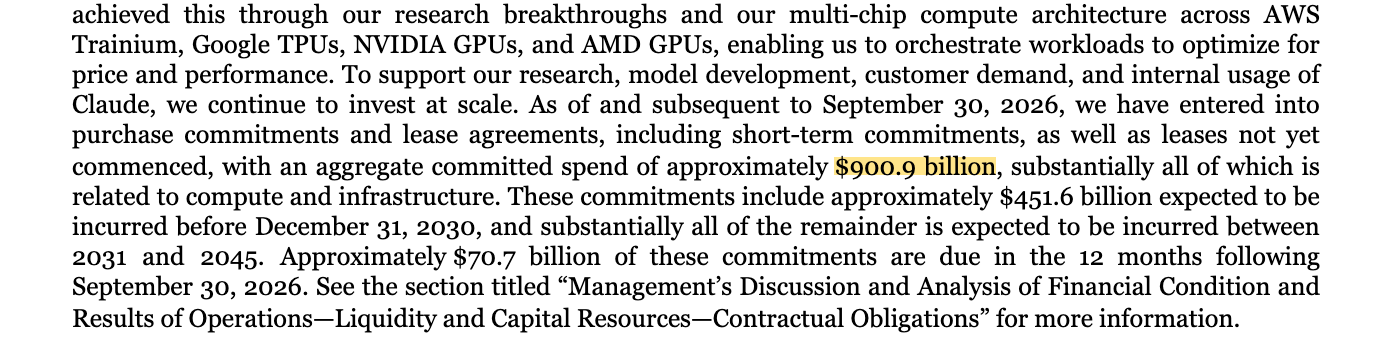
The second difference is in the S-1, the document a company files with the SEC before it goes public. The company has committed to spend about $900 billion on computing capacity over the coming years, although some of these contracts can be cancelled.
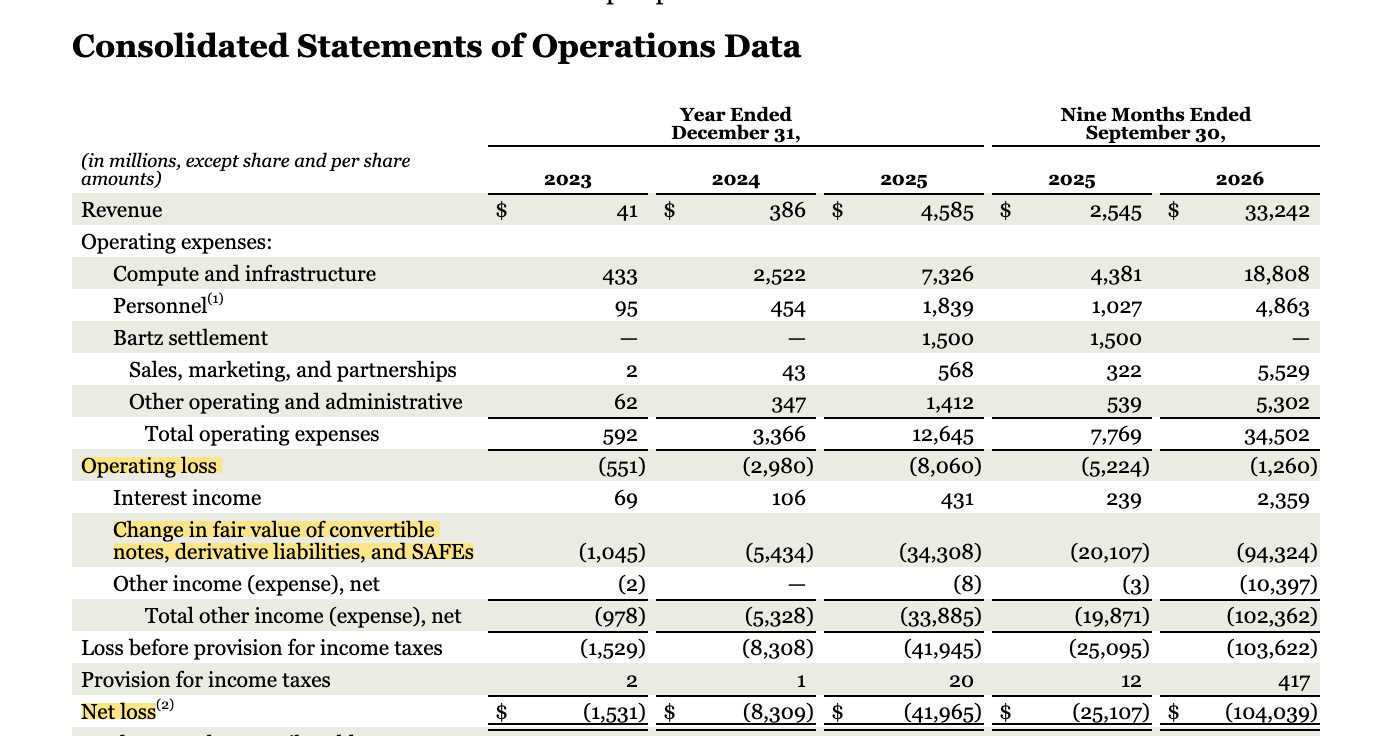
It also reports a very large net loss, but most of it comes from changes in the value of convertible notes (loans that can later turn into shares), and the operating loss is much smaller. Funnily enough, this accounting loss keeps Anthropic out of the S&P 500 for now, since that index requires a record of profits.
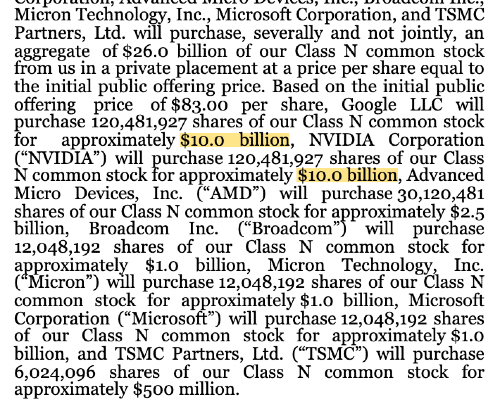
What is kinda cool is that the same companies play several roles at once. Take Google as an example. It already owned a large stake in Anthropic, and it bought another $10 billion of shares in a private placement alongside the IPO (shares sold directly to a few chosen investors, rather than through the offering).
At the same time, Anthropic rents Google’s chips through Google Cloud to train and run its models, and Google resells Anthropic’s models to its own cloud customers. In other words, Google is a shareholder, a supplier, and a distributor all at once.
Amazon plays a similar role, and the two cloud platforms together distributed close to half of Anthropic’s 2025 sales. Nvidia, which also bought $10 billion of shares in the placement, designs the chips that Anthropic rents through Microsoft’s cloud.
The third difference, and the one I find most unusual, is governance. Anthropic is a public benefit corporation (a legal form that writes a social mission into the company’s charter), which means its directors have to balance shareholder interests against a stated public purpose. It also separates three rights that usually come together in a share of stock, namely the right to the cash flows, the right to vote, and the right to choose the board.
Public shareholders get the cash flows and one vote per share, while Amazon’s and Google’s large stakes generally carry no votes. A single share held by the founders carries 50.1% of the vote. On its own, this kind of insider control is quite common, since about four in ten US IPOs last year had more than one class of shares (e.g. one class for the public and another with extra votes for the founders). The unusual part is the Long-Term Benefit Trust, a group of trustees set up to look after the company’s mission, which generally elects a majority of the board without owning any economic stake.
So the Anthropic IPO is in many ways an ordinary IPO, only much larger. The decision to list and the first-day jump follow a familiar pattern. Probably the interesting bits are the financing relationships and the governance, since some of the companies that supply computing capacity also bought shares, and a trust without an economic stake elects most of the board.
Other Stuff
- Bloomberg reports that banks are studying how early signs of dementia show up in customers’ financial data. This makes sense, since managing money is often one of the first abilities to decline, and banks see the data before anyone else does. (Will this mean an MBA for the elderly?)
- The NYT looks at the boom in Pokemon card collecting as an investment. Like any collectible, the card pays no dividends, so the return depends entirely on someone else wanting the same card later at a higher price.
- ProPublica finds that companies are receiving tariff refunds, but customers should not expect lower prices. Not too surprising, since prices that went up with tariffs tend to be sticky once customers have gotten used to them.
- Barron’s reports that swapping one ETF for a similar one to harvest tax losses is now widespread. The wash-sale rule bans buying back a “substantially identical” security, and nobody quite knows how different two S&P 500 funds from different issuers need to be.