[Week 42 of 2026] Prediction Markets
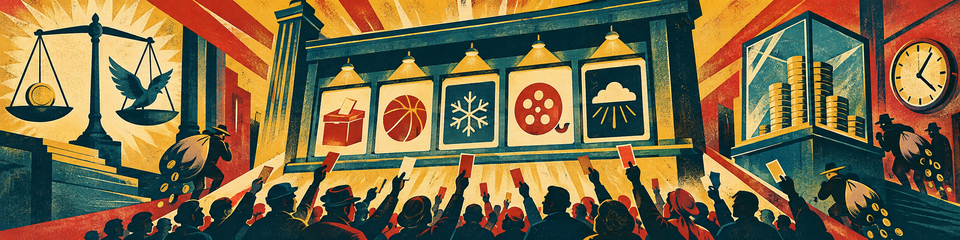
Welcome back to Price and Prejudice with a few musings from Week 42 of 2026. Today we talk about prediction markets, and what their prices do and do not tell us.
One of the oldest ideas in economics is that prices carry information that is scattered across many people. No single person knows how much copper the world will need next year, but the price of copper reflects what thousands of buyers and sellers know about it. The catch is that in most markets it is hard to trace whose information ends up in the price. We see the price, and we have to guess at what it means.
Prediction markets make this question unusually concrete. A contract pays $1 if a specific event happens, such as a candidate winning an election, the Fed raising rates, or a team winning a game, and $0 otherwise. These markets have become very large, with Kalshi alone recording roughly $240 billion of trading volume this year through September, according to the tracker Volume Race. This week, Reuters reported that betting on this year’s congressional races has already passed $220 million, compared with $92 million for the entire 2024 cycle, and that on Polymarket the top 1% of wallets account for 70% of the volume in those markets.
Two platforms make most of the headlines. Kalshi is a CFTC-regulated US exchange that has been allowed to list election contracts since a 2024 court ruling. Polymarket’s main platform runs on a public blockchain and blocks US users, but the company now also runs a separate, regulated US venue.
On both, contracts are fully collateralized, meaning that every contract is backed by the full $1 it could pay out. If you buy Yes at 60 cents, someone else buys No at 40 cents, and the exchange holds the combined $1 until the event resolves and then pays it to the winning side. As a result, there is no leverage and no margin call, the most you can lose is what you paid, and you can sell your position to another trader at any time before the event resolves. The main legal fight is over sports, which states want to regulate as gambling, and on October 9 the CFTC proposed rules that would treat such contracts as swaps, a category of derivatives under its own jurisdiction.
The platforms describe what they do as the wisdom of crowds, and the media increasingly report prices as probabilities, as in “the market gives the Fed a 60% chance of hiking.” I find it useful to ask two questions about these markets. What exactly does the price represent? And who is making it accurate?
Let's start with the first question. The tempting reading is that a contract trading at 60 cents means a 60% chance. A useful way to see when that is right is to write the price as
× value of a dollar if the event happens
× discount for waiting
The first term is the real-world probability. The second term is where finance comes in. If a dollar is worth the same to investors whether or not the event happens, this term equals one, and after adjusting for the time value of money the price is the probability. If the event tends to happen in bad times, when an extra dollar is worth more, the price will be higher than the probability. Finance calls the probability implied by the price a risk-neutral probability, i.e., the real-world probability tilted toward the outcomes people most want to be paid in.
The tilt matters because people can use these contracts as insurance. For example, a theater chain can buy contracts paying off if studios release fewer than 60 films in a quarter, which offsets lost ticket sales, and an ice cream shop can bet on cold weather to cover slow days.
The same logic applies to bigger risks. Someone worried that a recession would hurt their job and their portfolio could buy a contract that pays off in a recession, and as with any insurance, hedgers may be willing to pay more than the expected payout. A recession contract trading at 30 cents could therefore correspond to a lower real-world probability, with the difference being an insurance premium.
How large is the gap in practice? For a basketball game, a dollar is probably worth about the same to most traders whether the home team wins or not, so the price should be a reasonable estimate of the probability. Even for macroeconomic events, the evidence so far suggests the gap is modest. Economists at the Fed find that Kalshi’s markets on inflation, unemployment, and Fed decisions are reasonably well calibrated, with low inflation and unemployment outcomes occurring somewhat more often than the market distributions implied, which is what one would expect if traders pay a premium to insure against high inflation and unemployment.
The third term, the discount for waiting, matters more than it looks because of how these contracts are collateralized. Since every contract is backed by the full $1, betting against an unlikely event ties up almost a dollar to win a few cents. For example, Polymarket has a contract on whether Jesus Christ will return before 2027, which traded at around 4 cents in February. Betting No meant putting up about 96 cents and waiting until the end of the year to collect 4 cents, which is roughly what the same money would have earned in Treasury bills. Nobody will bet No for less than that, so the price of Yes cannot fall much below the interest rate, and a price like this is closer to an interest rate than to a probability. The same force props up the price of any long shot that resolves far in the future. Paying interest on positions shrinks this effect, and both platforms now do some of this, with Kalshi paying a variable 3.5% on cash and open positions and Polymarket offering a similar holding reward on selected markets.
There is also a wedge that has nothing to do with risk, which is that people like lottery tickets. In horse racing and sports betting, long shots tend to be overpriced relative to how often they win, a pattern known as the favorite-longshot bias, and prediction markets show the same tendency. Bloomberg reported earlier this month that long-shot contracts dominate trading on Kalshi and Polymarket, and that money staked on long shots since early 2025 has lost about 15% on Kalshi and 27% on Polymarket. So a contract at 3 cents may well correspond to a real-world probability below 3%. More generally, the price reflects the views of the traders who put money behind them, weighted by how much they put in, which is not the same as the average view of everyone watching.
The second question is who makes the price accurate. Every market has informed traders, i.e. those who know something; noise traders, who trade for other reasons such as hedging, entertainment, or conviction; and market makers, who stand ready to buy or sell. Market makers lose money to informed traders and make it back from everyone else through the spread. Prediction markets that settle on a public blockchain let us see this directly. A recent study using every trade on Polymarket finds that market makers anticipate short-term price moves well but tend to end up on the wrong side when the event resolves, which is what one would expect if the people trading against them near the end know more about the outcome.
This also tells us who makes money. Prices can only become accurate if someone is paid to make them accurate, and the payment has to come from someone else. In the same study, a small share of accounts earns a large share of the gains, while about two-thirds of accounts lose money, and the trading of most accounts tends to move prices away from the eventual outcome.
It is worth connecting this back to the first part, though. Not every loser is making a mistake. Someone buying insurance against a recession, or a sports fan paying for the fun of a long shot, can lose money on average and still be getting what they paid for. So the profits of the winners are partly payment for information, partly payment for bearing risk, and partly payment for providing liquidity, and the crowd’s role is less to be wise than to pay for these services.
So how should one read a prediction-market price? I would treat it as a risk-neutral, money-weighted number, set by a market in which a small group of traders is paid by everyone else for information, risk bearing, and liquidity. For a basketball game, that is close to a probability. For events that people want to insure against, the price can sit above the real-world probability, and the size of that gap is itself a measure of how much people are willing to pay to avoid the outcome.
Other Stuff
- Cboe is extending trading hours for stock and ETF options, another step toward markets that rarely close.
- KFC is moving to ditch Pepsi for Coke in thousands of its restaurants, a reminder that fountain-drink contracts are one of the quieter battlegrounds in consumer goods.
- European salmon farmers are starting to feed chicken to their fish.
- Younger Americans are changing jobs less than they used to, which matters because job-hopping has historically been one of the main ways young workers get raises.